Car Interior Restoration Cost: The Complete 2026 Pricing Guide
Published: 18 Jun.2026
Cracked dashboards. Sagging headliners. Leather seats that look more “weathered barn jacket” than “luxury sedan.” If your cabin has seen better days, you’ve probably typed “car interior restoration cost” or “car interior repair cost“ into Google and landed on a pile of vague answers.
Most guides either bury you in classic-car restoration math that has nothing to do with your daily driver, or they hand you one flat number that ignores everything that actually affects your bill. This guide does neither. Below, you’ll find real cost ranges broken down by component, material, vehicle type, and region, plus the hidden fees, resale-value math, and quote-checking tips that most articles skip entirely.
Car Interior Restoration Cost at a Glance
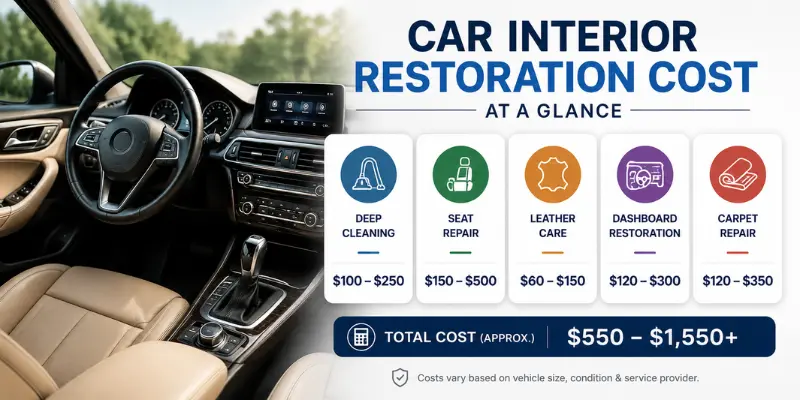
Before the details, here’s the short version. Most car interior restoration projects fall into one of three tiers:
| Restoration Tier | What’s Typically Included | Average Cost |
|---|---|---|
| Spot Repair | One or two damaged areas: a torn seat panel, a cracked dash section, a stain | $75 – $400 |
| Partial Restoration | Seats plus one or two other areas (carpet, headliner, or door panels) | $800 – $3,500 |
| Full Interior Restoration | Seats, dashboard, headliner, carpet, door panels, and console refreshed together | $3,000 – $12,000+ |
Classic and collector cars, and any full leather upgrade on a luxury vehicle, can push well past $12,000. We’ll cover why later on.
These numbers come from typical pricing across upholstery shops, auto detailers, and restoration specialists. Always treat them as a planning range, not a quote. No two cars, and no two damaged seats, are exactly alike.
What Actually Drives the Cost of Interior Restoration
Six factors do almost all the work in determining your final invoice. Understanding them helps you spot a fair quote from an inflated one.
1. Extent and Type of Damage
A one-inch seam split takes a technician under an hour to fix. A seat with collapsed foam, torn stitching, and sun-faded color can take half a day. Damage type matters as much as size:
- Cuts and tears are the cheapest to address since they’re a stitching and patching job.
- Sun fading and discoloration require dye-matching and recoloring, which adds labor even when there’s no structural damage.
- Burns and deep stains sometimes mean replacing a whole panel rather than patching it.
- Mold, mildew, or pet odor requires remediation before any cosmetic work begins, and this step is frequently quoted separately.
2. Material Choice
Material is the single biggest lever you control. Cloth costs the least to source and install. Genuine leather, Alcantara, and exotic hides cost significantly more in both material and skilled labor. We’ve broken this down fully in the material comparison table below.
3. Vehicle Size and Seat Count
A two-seat coupe simply has less surface area than a three-row SUV. More seats, more door panels, and more square footage of carpet and headliner all add directly to material and labor costs.
4. Age and Complexity of the Vehicle
Modern interiors often include heated seats, lumbar motors, occupancy sensors, and ambient lighting. Removing and recalibrating these systems adds time and, often, a separate electronics line item. Classic cars introduce a different complexity: original materials may be discontinued, requiring custom sourcing or hand-fabrication that takes far longer than swapping in an off-the-shelf seat cover.
5. Labor Rates and Shop Type
Independent upholstery shops typically charge $50–$100 per hour. Specialized restoration studios and dealerships charge $100–$200 per hour, reflecting more experienced technicians and higher overhead. This is also where region plays a major role, which we’ll cover next.
6. Add-On Services
Odor removal, ceramic coating for upholstery, stain-guard treatments, and expedited turnaround all sit outside the “core” repair price. Ask upfront whether your quote includes them.
You May Also Like It:
Car Leather Seat Repair Guide: Kits, Costs & Tips
Car Suspension Repair Cost: Complete Guide for 2026
Car Cooling System Repair: The Complete Guide Every Driver Needs
Interior Restoration Cost by Component
Here’s where most guides stop short. Below is a complete component-by-component breakdown so you can estimate a realistic total instead of guessing.
| Component | Service | Average Cost Range |
|---|---|---|
| Seats | Patch or small tear repair (per seat) | $75 – $200 |
| Seats | Full reupholstery, cloth (per seat) | $250 – $600 |
| Seats | Full reupholstery, leather (per seat) | $500 – $1,500 |
| Dashboard | Crack filling and texture/color match | $150 – $400 |
| Dashboard | Full dash skin replacement or recover | $400 – $900 |
| Headliner | Resag/reattach (no new material) | $100 – $250 |
| Headliner | Full replacement | $200 – $700 |
| Carpet | Shampoo and deep clean only | $75 – $200 |
| Carpet | Full carpet replacement (OEM-style) | $300 – $900 |
| Door Panels | Repair or recover (per panel) | $100 – $350 |
| Center Console / Trim | Refinish or wrap | $150 – $500 |
| Steering Wheel | Re-wrap or leather refinish | $150 – $400 |
| Odor/Stain Removal | Ozone treatment and deep cleaning | $75 – $300 |
| Mold Remediation | Deep extraction and sanitizing | $150 – $600 |
A full, whole-cabin restoration usually combines several of these line items, which is why total quotes can range so widely. A 5-seat sedan getting seats, carpet, and a headliner refresh, for example, commonly lands between $2,500 and $5,000.
Cost by Vehicle Type
Seat count, cabin size, and material expectations shift dramatically by vehicle class. Here’s a realistic range for a full interior restoration by vehicle category:
| Vehicle Type | Typical Seat Count | Full Restoration Cost Range |
|---|---|---|
| Compact car or coupe | 2–4 | $1,200 – $4,000 |
| Sedan or mid-size SUV | 5 | $2,500 – $7,000 |
| Full-size SUV or truck | 5–7 | $3,500 – $9,000 |
| Luxury sedan or SUV | 5 | $6,000 – $15,000 |
| Classic or collector car | 2–5 | $1,000 – $12,000 (interior only; full vehicle restoration runs far higher) |
Classic car owners often ask about whole-vehicle restoration too. For context, a complete frame-off classic car restoration, including paint, mechanical work, and interior, typically runs $40,000 to $120,000, with the interior portion alone usually representing $1,000 to $12,000 of that total. If you’re only restoring the cabin and not the rest of the car, you’re looking at the lower figure, not the whole-project number.
Material Cost Comparison
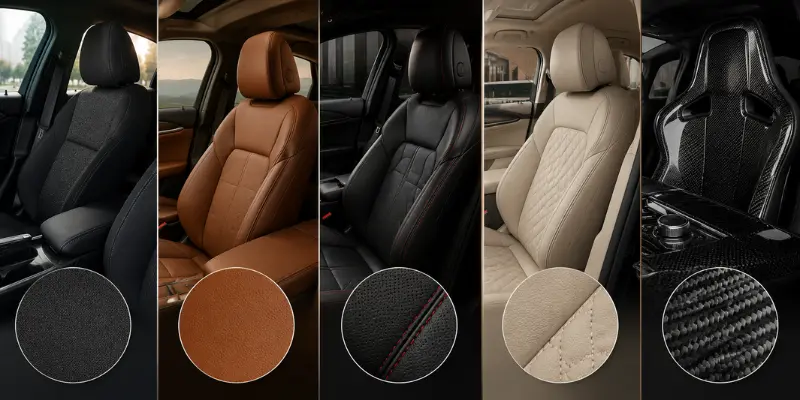
Material choice changes both your upfront cost and how the interior ages. Here’s how the common options stack up:
| Material | Feel and Durability | Cost per Seat (Material + Install) |
|---|---|---|
| Cloth | Breathable, budget-friendly, stains more easily | $200 – $500 |
| Vinyl | Water-resistant, easy to clean, less premium feel | $250 – $600 |
| Synthetic leather (leatherette) | Leather look, more affordable, moderate durability | $400 – $900 |
| Genuine leather | Premium feel, ages well with care, higher cost | $700 – $1,800 |
| Alcantara/microsuede | Sporty grip, stain-resistant, requires specialty cleaning | $900 – $2,000 |
A practical tip none of the big guides mention: you don’t have to commit to one material across the whole cabin. Many shops offer two-tone builds, leather on the seating surfaces with cloth or vinyl on the sides and back, which keeps the premium look on contact points while controlling overall cost.
How Region Affects Your Quote
Two identical repair jobs can cost noticeably different amounts depending on where you live, and this is something most pricing guides skip entirely.
- Climate matters more than people realize. Hot, sun-heavy regions (the Southwest, Florida, Southern California) see faster UV cracking and fading on dashboards and leather, which means more recoloring work even on “minor” jobs. Humid, coastal climates accelerate mold and mildew in carpet and foam padding, adding remediation costs that drier regions rarely need.
- Urban labor rates run higher. Shops in major metro areas often charge 20–40% more per hour than rural or small-town shops, simply due to higher rent and wages.
- Specialty material shipping adds up. If your shop has to special-order a specific leather grain or discontinued cloth pattern, freight charges can add 10–20% to material costs, especially outside major metro hubs.
When comparing quotes, ask whether the shop sources materials locally or ships them in. It’s a fast way to understand part of the price difference between two bids.
DIY vs Professional Restoration: A Real Cost Comparison
DIY can save real money on simple jobs, but it has clear limits.
| Job | DIY Cost | Professional Cost | Worth DIYing? |
|---|---|---|---|
| Small seat tear patch | $15 – $40 | $75 – $200 | Yes, with a quality patch kit |
| Carpet deep clean | $20 – $50 | $75 – $200 | Yes |
| Headliner resag | $30 – $80 | $100 – $250 | Sometimes, if you’re patient |
| Full seat reupholstery | Not realistic for most owners | $250 – $1,500 | No |
| Leather recoloring/dye match | $40 – $100 (kit), uneven results common | $200 – $500 | Rarely, color matching is hard to get right |
| Anything involving airbags or seat sensors | Not recommended | Varies | No |
The general rule: cosmetic, low-risk, single-surface jobs are reasonable DIY candidates. Anything involving structural foam, safety systems, or color matching across a whole cabin is worth paying a professional for, since a botched DIY attempt often costs more to fix than it would have to do properly the first time.
Hidden Costs to Watch For
A clean-looking quote can still leave room for surprises. Before you book, ask whether these are included:
- Disassembly and reassembly fees for seats with heating elements, lumbar motors, or occupancy sensors
- Recalibration charges for any safety system disturbed during the repair (seatbelt pre-tensioners, airbag covers)
- Rush fees for expedited turnaround, often 50–100% above standard pricing
- Freight or special-order surcharges for specific colors, grains, or discontinued materials
- Disposal fees for old foam, carpet, or upholstery
- Mold or odor remediation, which is almost always quoted as a separate add-on rather than bundled into the base price
A reputable shop will list these clearly. If a quote feels suspiciously low compared to others, ask directly what isn’t included.
Does Interior Restoration Pay You Back at Resale?
This is the question most pricing guides never actually answer, so here’s the honest math.
A worn, stained, or torn interior is one of the fastest ways to lose negotiating power on a private sale or trade-in. Buyers and dealers both use interior condition as a quick proxy for how well the rest of the car was maintained, fairly or not.
In practice:
- Spot repairs and deep cleaning ($75–$400) routinely return their cost several times over by removing the “this car wasn’t cared for” impression during a walkthrough.
- Partial restorations ($800–$3,500), such as reupholstering driver and passenger seats, tend to pay back 60–100% of their cost in added resale value or stronger negotiating position, especially on vehicles under 10 years old.
- Full restorations ($3,000–$12,000+) rarely return 100% of their cost dollar-for-dollar on a standard vehicle, but they shorten time-on-market and reduce lowball offers, which has real value even if it isn’t a line item on a bill of sale.
- Classic and collector cars are the exception. A correctly restored, period-appropriate interior can meaningfully increase a sale price, since buyers in that market specifically pay for authenticity and condition.
The practical takeaway: for everyday vehicles, prioritize the repairs a buyer will actually notice in a five-minute test sit, torn seats, bad odors, and visible dashboard damage, before investing in a full cabin overhaul purely for resale purposes.
Will Insurance Cover the Cost?
Sometimes, but not for the reason most people hope. Comprehensive auto insurance can cover interior damage caused by a covered event, such as vandalism, theft, fire, flooding, or a covered accident. It generally does not cover normal wear and tear, sun fading, or cosmetic aging, since insurers treat those as maintenance issues rather than incidents. If your damage stems from a specific event rather than years of use, it’s worth a quick call to your insurer before booking a shop.
How to Get an Accurate Quote
Use this checklist when comparing shops so you’re comparing like for like:
- Ask for a written, itemized quote, not a single bundled number
- Confirm whether disassembly, reassembly, and recalibration are included
- Ask specifically about rush fees and freight charges
- Request to see material samples in person, not just photos
- Ask about warranty length and what it actually covers (workmanship only, or materials too)
- Get at least two quotes for any job over $1,000
Maintaining Your Interior After Restoration
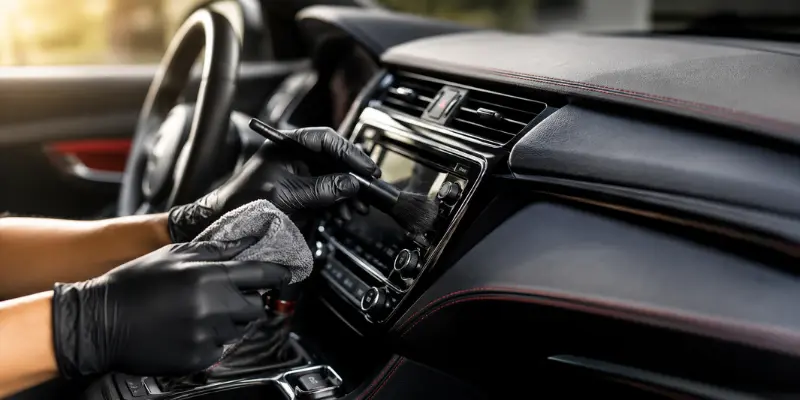
A restoration is only worth the investment if it lasts. A few habits go a long way:
- Condition leather every 2–3 months with a pH-balanced conditioner to prevent re-cracking
- Keep fabric vacuumed weekly and deep-clean quarterly to prevent embedded dirt from cutting fibers
- Use a sunshade on hot days; UV exposure is the single biggest cause of repeat dashboard and leather damage
- Address small damage immediately; a small tear left alone almost always becomes a bigger, more expensive repair
- Schedule an annual inspection so a technician can catch loosening trim or weakening foam before it becomes visible
FAQs
Most full interior restorations on a standard sedan or SUV fall between $2,500 and $9,000, depending on material choice and how many components (seats, dashboard, headliner, carpet) are included.
Yes. Leather restoration and reupholstery typically costs two to three times more than fabric, due to higher material costs and the specialized skill needed for color matching and stitching.
Spot repairs usually take 1–2 days. Partial restorations take 3–5 business days. Full cabin restorations typically take 5–10 business days, longer for classic cars needing custom-sourced materials.
Yes, and many owners do exactly this. Single-seat repairs or reupholstery are common and cost significantly less than restoring the entire cabin at once.
Sometimes. EVs often include more sensors, ambient lighting, and integrated technology in the seats and console, which can add disassembly and recalibration time compared to a comparable gas vehicle.
A deep clean paired with odor treatment and a single-seat repair often delivers the biggest visible improvement for the lowest cost, usually under $400 total.
The Bottom Line
Car interior restoration cost depends on far more than just “leather versus cloth.” Damage type, component count, vehicle class, region, and the fine print on your quote all shape the final number. Use the ranges in this guide to build a realistic budget, ask the right questions before you book, and prioritize the repairs that matter most for how you actually use, or plan to sell, your car.
You May Also Like It:
Rear Differential Repair Cost – Signs, Fixes, and How to Avoid a Huge Repair Bill
Car Door Lock Repair: Common Problems, Costs, and Easy Fixes
What Oil Does My Car Take? The Complete Guide to Choosing the Right Engine Oil






- Be Respectful
- Stay Relevant
- Stay Positive
- True Feedback
- Encourage Discussion
- Avoid Spamming
- No Fake News
- Don't Copy-Paste
- No Personal Attacks
- Be Respectful
- Stay Relevant
- Stay Positive
- True Feedback
- Encourage Discussion
- Avoid Spamming
- No Fake News
- Don't Copy-Paste
- No Personal Attacks
