Diagram What Wires Go to the Starter Solenoid?
Published: 08 Jul.2026
Your car will not start, and you are pretty sure the starter solenoid is involved. Maybe you hear one solid click when you turn the key. Maybe you hear nothing at all. Either way, you are looking at a starter solenoid wiring diagram and seeing terminals marked B, BAT, S, M, or sometimes I.
At first, it can look confusing. The starter solenoid is a small part, but it handles two very different jobs. It uses a small electrical signal from the ignition switch to control a much larger current from the battery. It also helps engage the starter drive so the engine can crank.
That is why starter solenoid wiring includes both thick high-current cables and thin control wires. If one wire is loose, corroded, or connected to the wrong terminal, the result can be a no-start problem, a single click, a weak crank, or a starter that does not engage properly.
This guide explains exactly what wires go to the starter solenoid, what each terminal does, and how to trace the wiring safely.
Simple Starter Solenoid Wiring Diagram
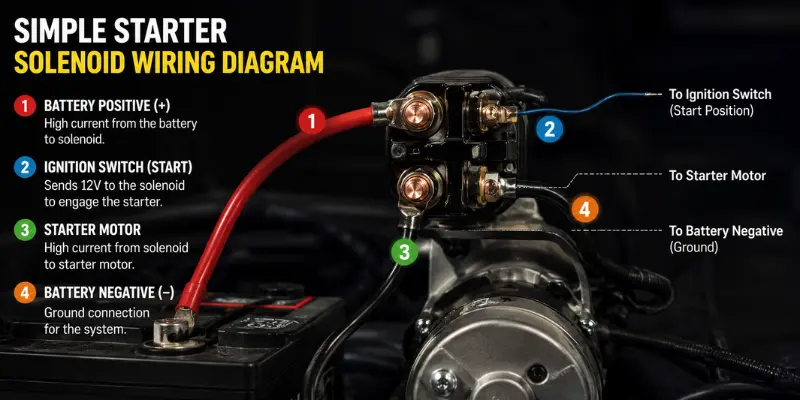
Here is the basic wiring layout most vehicles use:
Battery Positive (+)
        |
        | Heavy battery cable
        v
   B / BAT Terminal
   Starter Solenoid
   M Terminal
        |
        | Heavy starter cable
        v
   Starter Motor

Ignition Switch / Start Circuit
        |
        | Small trigger wire
        v
   S Terminal

Ground Path
        |
        | Through starter body, solenoid case, or ground wire
        v
   Engine Block / Chassis Ground
In simple words:
- The battery cable goes to the B or BAT terminal.
- The starter motor cable goes to the M terminal.
- The ignition switch trigger wire goes to the S terminal.
- The ground is usually through the starter body or solenoid mounting point, unless your vehicle uses a separate ground wire.
- Some older vehicles also have an I terminal, which is usually for ignition bypass, not the starter motor feed.
You May Also Like It:
Car Interior Restoration Cost: The Complete 2026 Pricing Guide
Car Radio Repair: The Complete Guide to Diagnosing and Fixing a Dead Radio
Cost for Repairing Scratches on Car – Complete 2026 Guide
What a Starter Solenoid Actually Does
Before connecting or testing wires, it helps to understand what the solenoid does.
A starter solenoid works as both:
1. An electromagnetic switch
It allows a small current from the ignition switch to control the large current needed by the starter motor.
2. A mechanical engagement device
On many starter-mounted solenoids, it moves a plunger that pushes the starter drive gear into the engine flywheel or flexplate.
This is why the solenoid has large terminals for battery power and starter motor current, plus smaller terminals for control wiring.
Starter Solenoid Terminals Explained
Most starter solenoids use some version of these terminals. The exact labels may vary depending on the vehicle make, model, and year.
1. Battery Terminal: B or BAT
The B or BAT terminal connects directly to the positive side of the battery.
This is usually the largest cable on the solenoid. It carries the high current needed to crank the engine.
Wire type: Heavy-gauge battery cable, often 2 AWG to 4 AWG
Power status: Always hot, even when the key is off
Common color: Red or unshielded heavy cable
Because this terminal is always connected to battery power, disconnect the negative battery cable before working near it.
2. Starter Motor Terminal: M
The M terminal connects the solenoid to the starter motor.
When the solenoid is activated, it closes the internal contact and sends battery power from the BAT terminal to the starter motor through the M terminal.
Wire type: Heavy-gauge cable
Power status: Hot only while cranking
Common color: Black, red, or unshielded heavy cable
This wire carries a lot of current for a short time. It must be tight, clean, and properly sized.
3. Start Signal Terminal: S
The S terminal is the small terminal that receives power when you turn the key to the start position.
This wire usually comes from the ignition switch, starter relay, neutral safety switch, clutch safety switch, or engine control circuit depending on the vehicle.
Wire type: Light-gauge wire, often 14 to 16 AWG
Power status: Hot only when the key is turned to start
Common colors: Purple, yellow, red/blue, or pink depending on the vehicle
This is one of the most important wires to test when the starter clicks but does not crank. If the S terminal gets weak voltage, no voltage, or an unstable signal, the solenoid may not engage correctly.
4. Ignition Bypass Terminal: I
Some older vehicles, especially older Ford-style remote solenoids, may have an I terminal.
The I terminal is usually not the starter motor terminal. It is commonly used to send full battery voltage to the ignition coil during cranking, bypassing a resistor wire or ballast resistor.
Wire type: Small control wire
Power status: Hot during cranking on vehicles that use this system
Common use: Ignition bypass on older systems
Not every starter solenoid has this terminal. Modern vehicles often do not use it.
5. Ground Connection
Some solenoids have a separate ground wire, but many ground through the starter body, solenoid case, or mounting bracket.
A bad ground can cause:
- One click but no crank
- Intermittent starting
- Slow cranking
- No response when turning the key
- Voltage drop under load
Make sure the starter mounting surface is clean, tight, and free of rust, paint, oil, or corrosion.
Starter Solenoid Wire Color Guide
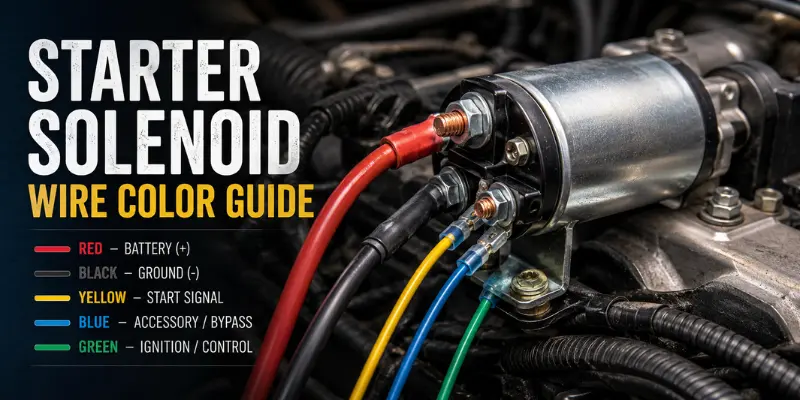
Starter solenoid wire colors are not universal. They change depending on manufacturer, model year, country, and whether the vehicle has aftermarket wiring.
Use this table only as a general guide.
| Wire Function | Common Wire Color |
|---|---|
| Battery positive cable | Red or unshielded heavy cable |
| Starter motor cable | Black, red, or unshielded heavy cable |
| Ignition/start trigger wire | Purple, yellow, pink, or red/blue |
| Ground wire | Black or brown |
| Ignition bypass wire | Brown, yellow, or other small wire depending on vehicle |
Never rely only on wire color. Always confirm with your vehicle’s wiring diagram or a multimeter.
You May Also Like It:
Car Leather Seat Repair Guide: Kits, Costs & Tips
Car Suspension Repair Cost: Complete Guide for 2026
Car Cooling System Repair: The Complete Guide Every Driver Needs
How to Trace Starter Solenoid Wires Safely
Follow these steps if you are not sure which wire goes where.
Step 1: Disconnect the Battery
Before touching the starter solenoid wiring, disconnect the negative battery cable.
The BAT terminal is usually live all the time, and a short circuit near the starter can cause sparks, melted wires, or battery damage.
Step 2: Locate the Starter Solenoid
On many modern vehicles, the solenoid is mounted directly on the starter motor. On some older vehicles, it may be mounted separately on the fender, firewall, or inner engine bay.
Step 3: Identify the Thick Cables
The thickest cable coming from the battery positive terminal goes to the B or BAT terminal.
The other thick cable usually goes from the solenoid to the starter motor and connects to the M terminal.
Step 4: Find the Small Trigger Wire
The small wire connected to the S terminal is the starter trigger wire.
This wire should only receive power when the key is turned to the start position.
Step 5: Check for an I Terminal
If your solenoid has an I terminal, check your vehicle’s factory diagram before connecting anything to it.
On many older systems, this terminal is for ignition bypass, not starter activation.
Step 6: Confirm the Ground Path
Check whether the solenoid has a dedicated ground wire. If it does not, the ground may come through the starter body or mounting bracket.
Clean the mounting area if there is rust, oil, or corrosion.
Step 7: Test With a Multimeter
Reconnect the battery only when you are ready to test.
Set your multimeter to DC voltage. Check the S terminal while someone turns the key to start. You should see close to battery voltage only during cranking.
Do not guess by jumping terminals with a screwdriver. That can be dangerous and may damage the vehicle.
Common Starter Solenoid Wiring Problems
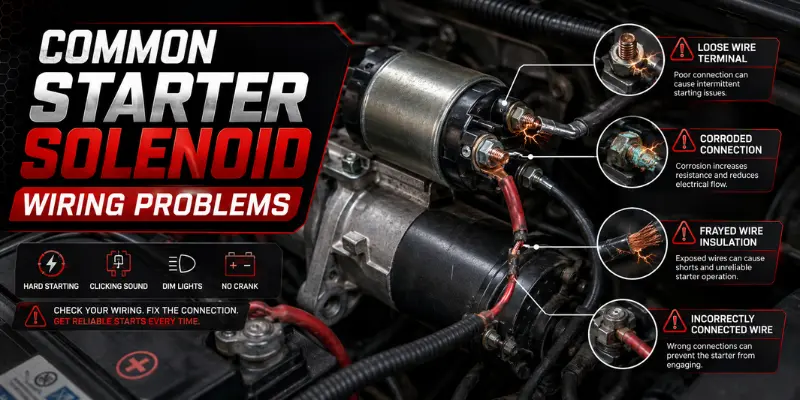
| Symptom | Possible Wiring Problem |
| Single click, no crank | Weak S terminal signal, bad ground, loose battery cable, bad solenoid |
| No click at all | No power to S terminal, bad ignition switch, blown fuse, bad relay |
| Starter spins but engine does not crank | Solenoid engagement issue, starter drive problem, wrong wiring |
| Slow crank | Loose battery cable, weak battery, voltage drop, poor ground |
| Intermittent starting | Corroded terminal, loose trigger wire, bad ground connection |
| Sparks or melted wires | Incorrect wiring, short circuit, undersized cable |
Common Wiring Mistakes to Avoid
Reversing the BAT and M Cables
Both cables are thick, so they can be confused. The battery cable must go to the B/BAT terminal, and the starter motor cable must go to the M terminal.
Connecting the Trigger Wire to the Wrong Terminal
The small ignition trigger wire belongs on the S terminal. If it is connected incorrectly, the solenoid may not engage.
Ignoring the Ground
A perfect wiring diagram will not help if the starter does not have a clean ground path. Always check the ground connection.
Using Wire That Is Too Thin
The battery and starter cables must be heavy enough to handle starter current. Undersized wiring can overheat and cause voltage drop.
Trusting Wire Colors Without Testing
Wire colors are helpful, but they are not proof. Older vehicles, repaired harnesses, and aftermarket wiring may not follow factory colors.
Adding Aftermarket Remote Start Incorrectly
Remote starters and alarm systems can interfere with the starter circuit if they are not wired through the proper relay, neutral safety switch, or clutch safety switch.
Quick Reference Checklist
Before finishing the job, check the following:
- Battery positive cable is connected to the B/BAT terminal
- Starter motor cable is connected to the M terminal
- Ignition trigger wire is connected to the S terminal
- Optional ignition bypass wire is connected only if your vehicle uses an I terminal
- Ground path is clean, tight, and free of corrosion
- Battery terminals are clean and tight
- All nuts and terminals are secure
- Wiring has been tested with a multimeter
- No wire is rubbing against hot or moving parts
When to Call a Professional
You should contact a mechanic or auto electrician if:
- You see melted wires
- You smell burning insulation
- The vehicle has unknown aftermarket wiring
- The wiring harness has been modified
- The starter still does not work after confirming all connections
- You are not sure which terminal is BAT, M, S, or I
- The vehicle uses a complex computer-controlled starting system
Some no-start problems are not caused by the solenoid itself. A bad relay, fusible link, neutral safety switch, clutch switch, ignition switch, or engine control module signal can also stop the starter from working.
FAQs About Starter Solenoid Wiring
Most starter solenoids have a heavy battery cable, a heavy starter motor cable, a small ignition trigger wire, and a ground path. Some older vehicles also have an ignition bypass wire connected to the I terminal.
The battery positive cable goes to the B or BAT terminal. This terminal is usually always live, so disconnect the battery before working on it.
The small wire is usually the ignition trigger wire. It connects to the S terminal and receives power only when the key is turned to the start position.
Some starter solenoids use a separate ground wire, but many ground through the starter body or mounting bracket. A dirty or corroded ground can cause clicking, slow cranking, or no-start problems.
The I terminal is usually an ignition bypass terminal found on some older vehicles. It can send full voltage to the ignition coil during cranking. Not every vehicle uses it.
Yes. Incorrect wiring can cause melted wires, blown fuses, starter damage, ignition switch damage, or battery drain. Always confirm the wiring before connecting power.
A click with no crank can be caused by a weak battery, loose cable, poor ground, bad solenoid, bad starter motor, or low voltage at the S terminal.
Final Thoughts
A starter solenoid wiring diagram looks difficult at first, but the basic idea is simple. The thick wires handle high current between the battery and starter motor. The small wire tells the solenoid when to activate. The ground path completes the circuit.
The most important thing is not to rely only on wire color. Always confirm each connection with your vehicle’s wiring diagram and a multimeter. Once you understand the difference between the BAT, M, S, and optional I terminals, tracing starter solenoid wires becomes much easier and safer.
You May Also Like It:
Rear Differential Repair Cost – Signs, Fixes, and How to Avoid a Huge Repair Bill
Car Door Lock Repair: Common Problems, Costs, and Easy Fixes
What Oil Does My Car Take? The Complete Guide to Choosing the Right Engine Oil




- Be Respectful
- Stay Relevant
- Stay Positive
- True Feedback
- Encourage Discussion
- Avoid Spamming
- No Fake News
- Don't Copy-Paste
- No Personal Attacks
- Be Respectful
- Stay Relevant
- Stay Positive
- True Feedback
- Encourage Discussion
- Avoid Spamming
- No Fake News
- Don't Copy-Paste
- No Personal Attacks
