Car Cooling System Repair: The Complete Guide Every Driver Needs
Published: 14 Jun.2026
Your car’s engine runs hot — very hot. Without a properly functioning cooling system, temperatures inside your engine can exceed 4,000°F during combustion. The cooling system keeps things under control, but when it fails, the damage can be catastrophic and expensive. This guide walks you through everything: how your cooling system works, how to spot problems early, what repairs cost, and how to find trustworthy car cooling system repair near you.
How Your Car’s Cooling System Actually Works
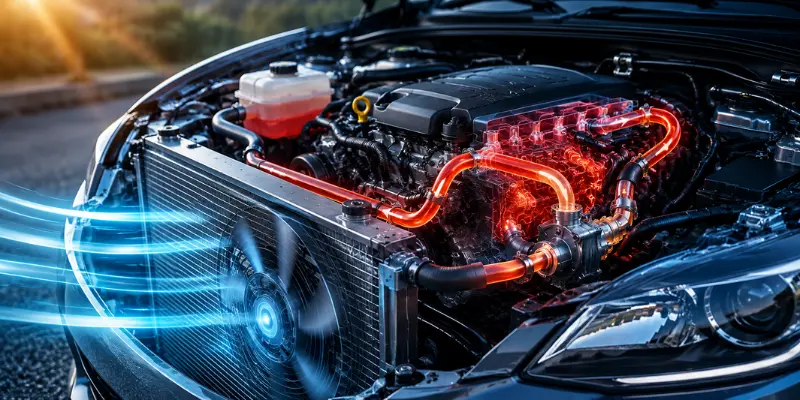
Most drivers know coolant goes somewhere under the hood — but understanding how the system actually functions helps you catch problems faster and make smarter repair decisions.
Your cooling system is a closed loop of interconnected components:
- — The heart of the system. It circulates coolant (antifreeze mixed with water) through the engine and back to the radiator constantly while the engine runs.
- — A heat exchanger at the front of the car. Hot coolant flows in, air passes through the fins, and cooled fluid flows back out.
- — A temperature-controlled valve. It stays closed when the engine is cold (to warm up faster) and opens at around 195°F to allow coolant to flow through the radiator.
- — Upper and lower radiator hoses, plus heater hoses, carry coolant between components. They’re under pressure and degrade over time.
- — Controls system pressure (usually 13–16 PSI). A faulty cap causes coolant to boil at a lower temperature and can result in leaks.
- — Provide airflow through the radiator when the car is stationary or moving slowly. These may be mechanical (belt-driven) or electric.
- — A small radiator inside the dashboard. It uses engine heat to warm your cabin. A leaking heater core is often a hidden culprit behind coolant loss.
- — Holds excess coolant as it expands when hot and draws it back in when the engine cools.
⚠️ Coolant (antifreeze) doesn’t just prevent freezing — it also raises the boiling point, prevents corrosion, and lubricates the water pump seals. Using the wrong type can cause serious internal damage.
Warning Signs Your Cooling System Needs Repair
The earlier you catch a cooling system problem, the cheaper it is to fix. Here are the key warning signs to watch for:
1. Coolant Leaking from the Bottom of Your Car When Parked
Finding a puddle under your car after it’s been parked is one of the most obvious signs of a coolant leak. The fluid is usually:
- Green, orange, pink, or yellow depending on the coolant type
- Slightly oily or slippery to the touch
- Sweet-smelling — unlike oil or brake fluid
Coolant leaking from the bottom of your car when parked can point to a cracked radiator, failed lower hose, or damaged water pump seal. Don’t ignore it — even a slow drip can cause your coolant level to drop dangerously low.
2. Engine Overheating
Your temperature gauge should stay in the middle range during normal driving. If it creeps toward the red, pull over safely, turn off the engine, and let it cool for at least 30 minutes before investigating. Continuing to drive an overheating engine can warp the cylinder head or crack the engine block — repairs that cost thousands.
3. Sweet Smell Inside or Outside the Car
Ethylene glycol (the main ingredient in most coolants) has a distinctive sweet, almost syrupy smell. If you notice this odor from your vents, you likely have a leaking heater core. If you smell it outside the car, coolant is dripping onto a hot engine surface.
4. White Smoke or Steam from the Hood
Visible white steam from under the hood means coolant is hitting a hot surface or the engine is overheating. White exhaust smoke (from the tailpipe) that doesn’t clear up as the engine warms is a classic sign of a blown head gasket — coolant is burning inside the combustion chamber.
5. Milky or Foamy Oil
Check your oil dipstick. If it looks like a chocolate milkshake or has a creamy residue under the oil cap, coolant has mixed with the engine oil. This is almost always a blown head gasket and needs immediate professional attention.
6. Consistently Low Coolant Level
If you keep having to top off your coolant but can’t find any puddles, you may have an internal leak (such as a head gasket leak). The coolant is burning off inside the engine rather than dripping outside.
7. Bubbles in the Coolant Reservoir
Bubbling in the overflow tank is a red flag. It usually means combustion gases are leaking into the cooling system through a failing head gasket — a serious issue that needs a diagnosis right away.
You May Also Like It:
Car Leather Seat Repair Guide: Kits, Costs & Tips
Car Suspension Repair Cost: Complete Guide for 2026
What Oil Does My Car Take? The Complete Guide to Choosing the Right Engine Oil
Common Causes of Cooling System Failure
| Component | Common Failure | Urgency |
| Radiator hose | Cracking, bulging, soft spots | High |
| Radiator | Corrosion, impact damage, clogged fins | High |
| Water pump | Bearing failure, seal leak, impeller wear | High |
| Thermostat | Stuck open or closed | Medium |
| Head gasket | Blown from overheating or age | Critical |
| Heater core | Internal leak, blocked flow | Medium–High |
| Radiator cap | Worn seal, wrong pressure rating | Low–Medium |
| Coolant (fluid) | Depletion of inhibitors, contamination | Low–Medium |
Car Cooling System Repair Cost: What to Expect
One of the biggest questions drivers have is how much a car cooling system repair will cost. The answer depends on the component involved, whether you DIY or use a shop, and your vehicle type. Here’s a realistic breakdown:
| Repair Type | DIY Cost | Professional Cost | Difficulty |
| Radiator stop-leak additive | $10–$30 | $10–$30 + labor | Easy |
| Coolant flush & refill | $15–$50 | $100–$150 | Easy |
| Hose replacement (1 hose) | $15–$60 | $100–$250 | Easy–Medium |
| Radiator cap replacement | $10–$25 | $50–$100 | Easy |
| Thermostat replacement | $15–$50 | $150–$350 | Medium |
| Water pump replacement | $40–$150 | $300–$750 | Hard |
| Radiator replacement | $150–$400 | $400–$1,000 | Hard |
| Heater core replacement | $50–$200 | $500–$1,200 | Very Hard |
| Head gasket replacement | $150–$300 (parts) | $1,500–$3,000+ | Expert Only |
⚠️ Coolant leak repair cost for trucks is typically 20–40% higher than for standard cars due to larger components and more labor time.
What Drives the Price Up?
- Vehicle make and model — European luxury brands and trucks cost more to work on
- Labor rates — typically $80–$180/hour depending on location
- OEM vs. aftermarket parts — OEM parts cost more but often last longer
- Location of the leak — heater cores and head gaskets require many other parts to be removed first
- Age of the vehicle — older cars may have corrosion that complicates repairs
How to Find a Coolant Leak: Step-by-Step
Before you can fix it, you have to find it. Here’s how to locate a coolant leak safely and accurately:
- Let the engine cool completely — at least 2 hours after driving. Never open the radiator cap on a hot engine.
- Check the ground — look for puddles or staining under the front or middle of the car.
- Inspect the coolant reservoir — check the level and look for discoloration, oily residue, or bubbling.
- Visually inspect all hoses — look for cracks, soft spots, swelling, or wet areas. Run your fingers along the underside of each hose.
- Check hose clamps and connections — tighten any that feel loose.
- Start the engine and let it warm up — with the hood open, look for drips, steam, or wet areas developing. Keep hands and clothing away from moving parts.
- Use UV dye — many mechanics add UV dye to the cooling system and use a UV light to pinpoint the exact leak source, especially for hidden leaks.
- Perform a cooling system pressure test — if you still can’t find the leak, a pressure test kit (available at auto parts stores) pressurizes the system so leaks show themselves.
Car Cooling System Repair Kit: DIY Options That Actually Work
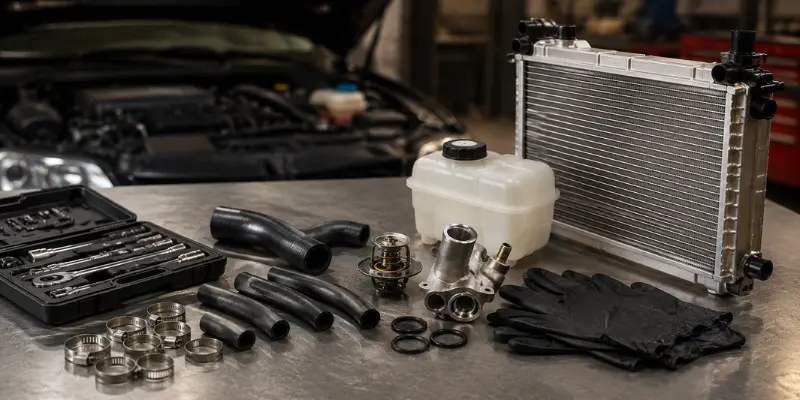
For minor leaks and maintenance tasks, a good car cooling system repair kit can save you significant money. Here’s what’s available and when to use each:
Radiator Stop-Leak Additives
These liquid sealants circulate through the cooling system and seal small pinhole leaks in the radiator, hoses, or heater core. They work best for very minor leaks and are a short-term solution while you plan a permanent repair. Use them sparingly — overuse can clog coolant passages.
Head Gasket Sealants
Products like Bar’s Leaks or Blue Devil Head Gasket Sealer claim to fix minor head gasket leaks without disassembly. They work on small internal leaks and can buy time, but they’re not a substitute for a proper mechanical repair on a seriously blown gasket.
Hose Repair Tape & Clamps
Self-fusing silicone tape and hose repair clamps can patch a cracked radiator hose temporarily. This is a roadside emergency solution only — replace the hose properly as soon as possible.
Full DIY Repair Kit
If you’re mechanically inclined, you can buy a complete cooling system service kit that includes a pressure tester, radiator cap tester, hoses, clamps, thermostat, and coolant. These run $50–$200 and are reusable for future maintenance.
⚠️ DIY repairs are suitable for hose replacement, thermostat replacement, and coolant flushes. Water pump and head gasket replacements should be left to professionals unless you have advanced mechanical experience.
When to See a Professional: Car Cooling System Repair Near Me
Some repairs should always be handled by a certified technician. Here’s when to stop DIYing and search for car cooling system repair near you:
- Your engine has already overheated — internal damage needs professional assessment
- You see milky oil or white exhaust smoke — a blown head gasket diagnosis requires special tools
- The heater core needs replacement — it’s buried deep inside the dashboard and requires significant disassembly
- You can’t locate the leak after a visual inspection — shops have pressure testers, UV lights, and borescopes
- Your water pump is failing — timing belt-driven water pumps require timing belt replacement at the same time
- Your vehicle is under warranty — DIY repairs may void coverage
How to Find a Reliable Shop
- Search specifically for ‘car cooling system repair near me’ and filter for ASE-certified shops
- Look for shops that offer free cooling system inspections or diagnostic services
- Ask if they use OEM or quality aftermarket parts
- Check Google Reviews specifically for cooling/radiator work — not just general ratings
- Get at least two estimates for repairs over $300
What Competitors Don’t Tell You: Insider Cooling System Facts
Your Coolant Type Matters More Than You Think
Not all antifreeze is the same. Using the wrong type can cause a chemical reaction that destroys your water pump, corrodes aluminum components, and turns your coolant into a gel. Here’s what you need to know:
| Coolant Type | Color | Common Use | Change Interval |
| IAT (Inorganic) | Green | Older vehicles (pre-2000) | Every 2 years / 30,000 mi |
| OAT (Organic) | Orange, Red, Pink | GM, VW, many modern cars | Every 5 years / 150,000 mi |
| HOAT (Hybrid) | Yellow, Turquoise | Ford, Chrysler, BMW | Every 5 years / 150,000 mi |
| NOAT (Nitrite-free) | Purple, Blue | European vehicles | Every 5 years / 150,000 mi |
⚠️ Always check your owner’s manual for the correct coolant specification. Never mix different coolant types — drain and flush the system completely before switching.
Electrolytic Corrosion: The Silent Cooling System Killer
This is one of the least-discussed causes of cooling system failure. As coolant ages, it becomes acidic and electrically conductive. This causes low-level electrical current to flow through the coolant, slowly eating away at aluminum components like the radiator, water pump, and cylinder heads. You can test for this with a cheap voltmeter — if you measure more than 0.1V in the coolant, it’s time for a flush.
The 50/50 Coolant Mix Rule
Most coolant bottles say to mix 50% antifreeze with 50% distilled water. Using tap water introduces minerals that cause scale buildup inside your cooling system. Distilled water is inexpensive and makes a real difference in cooling system longevity. Some manufacturers recommend 70/30 antifreeze-to-water ratios in extreme cold climates.
Electric Vehicles Have Cooling Systems Too
EVs don’t have traditional engines, but they still use liquid cooling systems for batteries, electric motors, and power electronics. EV cooling systems use non-conductive coolants and separate loops that should never be mixed with traditional automotive coolant.
Cooling System Maintenance: How to Prevent Expensive Repairs
Regular maintenance is the cheapest form of car cooling system repair. Here’s a straightforward schedule to follow:
| Interval | Maintenance Task |
| Every month | Check coolant level in the reservoir (engine cold) |
| Every 3 months | Visually inspect hoses and connections for wear or leaks |
| Every 6 months | Check radiator cap seal; test coolant freeze/boil protection with a test strip |
| Every 12 months | Inspect water pump for bearing play or weeping seals |
| Every 2–5 years | Complete coolant flush and refill (per manufacturer spec) |
| Every 60,000–100,000 mi | Consider replacing radiator hoses proactively (even if they look fine) |
Quick Tips to Extend Cooling System Life
- Never run the engine low on coolant, even briefly — cavitation in the water pump causes rapid wear
- Park in the shade when possible — prolonged heat soak degrades hoses and seals
- If your car has a timing belt-driven water pump, always replace the water pump with the timing belt
- Keep the front grille and radiator fins free of debris, bugs, and leaves
- Avoid using tap water in an emergency if at all possible — if you must, flush the system ASAP
FAQs
Not far, and not safely. Even a slow leak can cause the coolant level to drop below the minimum in as little as a few miles of driving. Once the coolant level drops, your engine temperature climbs fast. As a rule: if your temperature gauge is rising, pull over immediately.
This usually points to a lower radiator hose failure, a cracked radiator bottom tank, a water pump seal leak, or a head gasket failure allowing coolant to drip through the engine. The location of the puddle helps narrow it down — under the front of the car typically means radiator or hose; under the middle suggests water pump or heater core.
Yes, water will work temporarily to prevent overheating in an emergency, but plain water has a lower boiling point, no corrosion protection, and will freeze in cold weather. Get the proper coolant mix added as soon as possible.
Usually yes — cooling system repairs are almost always cheaper than a car payment. Even a $1,500 head gasket repair is financially worth it on a car with no monthly payment. The exception is when multiple major systems are failing simultaneously on a high-mileage vehicle.
Truck cooling system repairs generally run 20–40% higher than equivalent car repairs. For example, a water pump replacement that costs $400 on a sedan might run $550–$700 on a full-size pickup due to larger components, more coolant capacity, and additional labor time.
The clearest signs are: white exhaust smoke from the tailpipe, milky or foamy oil, coolant loss without any visible external leak, bubbles in the coolant reservoir, and the engine overheating frequently. A mechanic can confirm with a combustion gas leak test (also called a block test) or coolant pressure test.
Final Thoughts: Don’t Wait on Cooling System Problems
Car cooling system repair isn’t optional — it’s one of the most important things you can do to protect your engine. The good news is that most cooling system problems start small and give you plenty of warning signs before turning into catastrophic failures.
Act fast when you notice a sweet smell, a puddle, a rising temperature gauge, or low coolant. Whether you’re tackling a simple hose replacement at home, using a car cooling system repair kit for a minor leak, or searching for car cooling system repair near you for something more serious — the key is not to delay.
Regular maintenance checking coolant levels, inspecting hoses, and flushing the system on schedule will keep your cooling system running strong and help you avoid the bigger bills entirely. Your engine will thank you for it.
You May Also Like It:
Glass and Mirror Repair – A Clear Guide for Safer Driving and Better Visibility
Wheel Alignment With New Tyres – Do You Need It?
Golf Buggy Tyre Pressure – The Best PSI for a Safer, Smoother Ride


- Be Respectful
- Stay Relevant
- Stay Positive
- True Feedback
- Encourage Discussion
- Avoid Spamming
- No Fake News
- Don't Copy-Paste
- No Personal Attacks
- Be Respectful
- Stay Relevant
- Stay Positive
- True Feedback
- Encourage Discussion
- Avoid Spamming
- No Fake News
- Don't Copy-Paste
- No Personal Attacks
