Dual Turbo vs Twin Turbo – What’s the Real Difference?
Published: 02 Apr.2026
If you are confused about dual turbo vs twin turbo, you are not alone. Many car owners and even some websites use these terms as if they mean different things, while others use them interchangeably, which is why this topic often comes up in detailed auto comparisons.
The truth is simple: in most cases, dual turbo and twin turbo mean the same thing. Both usually describe an engine that uses two turbochargers instead of one. The bigger difference is not the name. The real difference is how the two turbos are arranged and how they work.
That is where things start to matter for performance, cost, turbo lag, and everyday driving.
In this guide, you will learn exactly what dual turbo and twin turbo mean, how they compare, and which setup may be better for your needs.
Quick Answer: Dual Turbo vs Twin Turbo

Dual turbo and twin turbo usually mean the same thing. Both terms commonly refer to an engine with two turbochargers.
However, there are different types of two-turbo systems, including:
- Parallel twin turbo
- Sequential twin turbo
- Compound turbo setup
So, when people compare dual turbo vs twin turbo, they are often comparing two names for the same basic idea. The real difference comes from the turbo layout, not the wording.
What Is a Turbocharger?
Before comparing the terms, it helps to understand what a turbocharger does.
A turbocharger uses exhaust gases from the engine to spin a turbine. That turbine pushes more air into the engine. More air allows more fuel to burn, which helps the engine produce more power.
This is why turbocharged engines can make strong power without needing a much larger engine.
What Does Dual Turbo Mean?
A dual turbo setup usually means the engine has two turbochargers.
People often use this term in a casual way. In many cases, it simply means the car has a two-turbo system. It does not always explain exactly how those two turbos are configured.
For example, a dual turbo setup could mean:
- two turbos working at the same time
- one turbo working first and the second joining later
- one turbo feeding air into the other in a more advanced setup
So, the term dual turbo is broad.
What Does Twin Turbo Mean?
A twin turbo setup also usually means the engine has two turbochargers.
In car listings, specifications, and performance discussions, twin turbo is often the more common term. But in everyday use, it usually points to the same idea as dual turbo.
That is why many people searching for dual turbo vs twin turbo are really asking this:
Are these two names different, or do they mean the same thing?
Most of the time, they mean the same thing.
Dual Turbo vs Twin Turbo – The Main Difference
Here is the clearest answer:
- Dual turbo = usually two turbochargers
- Twin turbo = usually two turbochargers
- In most cases, they are interchangeable terms
The important difference is not dual vs twin.
The important difference is whether the system is:
- parallel
- sequential
- compound
That is what affects how the engine responds, how much power it makes, and how expensive it is to build or repair.
Types of Twin or Dual Turbo Setups
This is the part many articles do not explain well enough.
1. Parallel Twin Turbo
In a parallel twin turbo setup, both turbos are usually the same size and work together at the same time.
This setup is common on engines where the cylinders can be split evenly, such as V6 or V8 engines.
Benefits of parallel twin turbo
- good power delivery
- strong top-end performance
- better airflow than one small turbo
- often smoother than one very large turbo
Drawbacks
- more parts
- more plumbing
- more heat
- more cost than a single turbo
2. Sequential Twin Turbo
In a sequential twin turbo setup, one turbo works more at lower RPM, and the second turbo helps more as RPM rises.
This setup is designed to improve response at low speed while still giving strong power at higher speed.
Benefits of sequential twin turbo
- less turbo lag
- strong mid-range power
- broader powerband
- better drivability in some setups
Drawbacks
- more complicated design
- more expensive
- harder to tune and maintain
3. Compound Turbo Setup
A compound turbo system also uses two turbos, but it works differently from a normal twin turbo setup. In this design, one turbo feeds compressed air into the other.
This setup is more common in heavy-duty diesel or specialized high-boost builds.
Benefits of compound turbo
- very high boost potential
- strong airflow
- excellent for certain diesel applications
Drawbacks
- highest complexity
- expensive
- not ideal for every driver
- more difficult to install and manage
Why the Terms Confuse So Many People
There are a few reasons why dual turbo vs twin turbo confuses readers.
1. Many websites use the terms loosely
Some writers say dual turbo. Others say twin turbo. Many mean exactly the same thing.
2. Marketing language adds confusion
Car brands sometimes use names that sound technical but do not clearly explain the turbo layout.
3. The real difference is in the setup
Two cars may both be called twin turbo, but one could be parallel while the other is sequential.
That is why the label alone is not enough.
Dual Turbo vs Twin Turbo Pros and Cons
Since both terms usually mean a two-turbo setup, the pros and cons are often the same.
Pros
- more power potential than many basic single-turbo setups
- better airflow
- can improve throttle response
- can reduce lag in the right design
- strong performance from smaller engines
Cons
- more expensive than a single turbo
- more complicated to install
- more parts to maintain
- more heat in the engine bay
- repairs can cost more
MORE USEFUL LINKS THAT YOU WILL LIKE:
Hyundai Elantra vs Sonata – Which Hyundai Sedan Is Better for You?
Best Mileage for a Used Car – A Smart Buyer’s Guide
Cracks in Tyre Sidewall – What They Mean and When to Replace the Tyre
Dual Turbo vs Twin Turbo vs Single Turbo
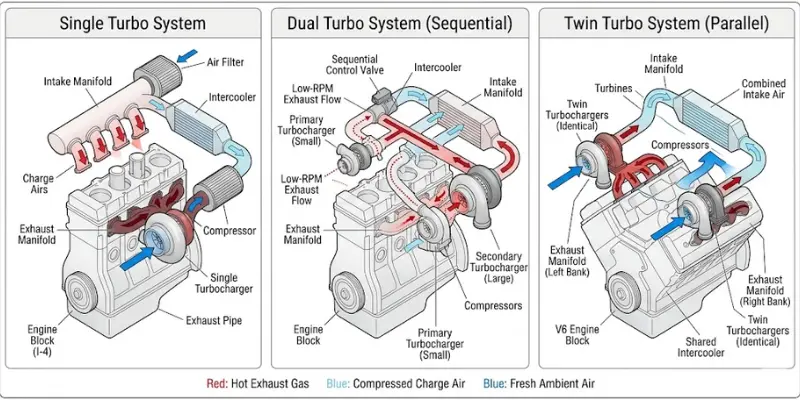
A lot of readers searching this keyword also want to know how two-turbo systems compare with a single turbo.
Single Turbo
A single turbo uses one turbocharger.
Pros
- simpler setup
- cheaper
- easier to maintain
- easier to tune in many cases
Cons
- may have more lag if the turbo is large
- one turbo must handle all airflow demand
Dual or Twin Turbo
A dual or twin turbo setup uses two turbochargers.
Pros
- stronger airflow
- better flexibility in power delivery
- can improve response
- excellent for performance-focused engines
Cons
- more complex
- more expensive
- harder to package
- more maintenance over time
Which Is Better: Dual Turbo or Twin Turbo?
If the terms are being used in the normal way, this is really a trick question.
Dual turbo is not automatically better than twin turbo, because they usually mean the same thing.
The better question is:
Which two-turbo setup is best for your goal?
Here is the practical answer.
Best for daily driving
A simpler setup is often easier to own. A factory-designed two-turbo system can still be great, but simplicity matters.
Best for performance
A two-turbo setup can be excellent for strong power and faster response.
Best for diesel towing or high-boost builds
Compound or staged setups are often better for more specialized heavy-duty performance goals.
Best for budget builds
A single turbo is usually cheaper and easier.
Cost: What Most Articles Leave Out
One of the biggest mistakes competitor articles make is not explaining the real cost clearly enough.
With a two-turbo setup, you are not just paying for two turbos.
You may also be paying for:
- extra piping
- more labor
- more tuning
- more fabrication
- more heat management
- more maintenance later
So when comparing dual turbo vs twin turbo, cost is usually not the real issue.
The real issue is:
How complex is the setup, and is that complexity worth it for your goals?
Reliability: Is a Two-Turbo Setup Less Reliable?
Not always.
A well-engineered factory two-turbo system can be very reliable. But in general, more parts mean more possible problems over time.
That includes:
- more hoses and clamps
- more heat
- more components that can wear out
- more tuning sensitivity in custom builds
So reliability depends heavily on:
- build quality
- maintenance
- tuning
- installation quality
Quick Comparison Table
| Setup | Meaning | Best For | Main Downside |
| Dual Turbo | Usually two turbos | Performance and balanced airflow | More complexity |
| Twin Turbo | Usually two turbos | Performance and broader tuning options | Higher cost |
| Sequential Twin Turbo | Two turbos working in stages | Better low-end and high-end balance | Complex design |
| Compound Turbo | One turbo feeds another | High-boost diesel or specialty builds | Most expensive and complex |
| Single Turbo | One turbo | Budget and simpler builds | Can have more lag |
FAQs
Yes, in most cases they mean the same thing. Both usually describe an engine with two turbochargers.
It depends on your goals. Twin turbo can offer better response and power delivery, but it is more complex and more expensive.
Twin turbo is a broad term for two turbos. Sequential turbo is a specific type of twin-turbo setup where the turbos work in stages.
Not exactly. Compound turbo also uses two turbos, but one turbo feeds the other. It is a more specialized setup.
For many drivers, a simpler setup is easier to live with. A factory-engineered twin-turbo car can still be excellent for daily use.
Final Verdict
When it comes to dual turbo vs twin turbo, the terms usually mean the same thing.
The real difference is not the name. The real difference is how the two turbochargers work together.
If you want the simplest possible answer, here it is:
Dual turbo and twin turbo usually refer to the same two-turbo setup, but the layout—parallel, sequential, or compound—is what really matters.
If you are choosing between turbo setups, focus on:
- your budget
- your performance goals
- your maintenance expectations
- whether the setup is factory-built or custom-built
That will give you a much better answer than the label alone.
MORE USEFUL LINKS THAT YOU WILL LIKE:
Car Door Handle Repair Cost: What You Should Expect to Pay
Wheel Alignment With New Tyres – Do You Need It?
Car Buying Guide Texas: How to Buy Smart and Avoid Costly Mistakes






- Be Respectful
- Stay Relevant
- Stay Positive
- True Feedback
- Encourage Discussion
- Avoid Spamming
- No Fake News
- Don't Copy-Paste
- No Personal Attacks
- Be Respectful
- Stay Relevant
- Stay Positive
- True Feedback
- Encourage Discussion
- Avoid Spamming
- No Fake News
- Don't Copy-Paste
- No Personal Attacks
