Hot Wheels Value Guide – How Much Are Your Cars Really Worth?
Published: 06 Jul.2026
That shoebox of Hot Wheels in your closet could hold a $2 car — or a $2,000 one. The tricky part is that valuable Hot Wheels often look almost identical to common ones when you do not know what to check. This wheels guide walks you through everything step by step, including which eras and castings are worth money, how to grade condition, how to identify Treasure Hunts and Redlines, how to spot fakes or restorations, and where to sell for the best return. Most Hot Wheels are worth pocket change, but the right Redline, Super Treasure Hunt, RLC release, rare color, or factory error can be worth serious money.
Quick Answer: What Makes a Hot Wheels Car Valuable?
Four main factors decide the value of any Hot Wheels car:
| Factor | Why It Matters |
|---|---|
| Era | Vintage Redlines from 1968–1977 are usually the most valuable period. |
| Rarity | Limited runs, rare colors, Treasure Hunts, errors, and convention releases can raise value. |
| Condition | A mint car can sell for many times more than the same car with play wear. |
| Packaging | A sealed carded car is often worth much more than the same car loose. |
A Hot Wheels car becomes more valuable when it checks more than one box. For example, a common loose mainline car may only be worth $1, but a rare Redline in excellent condition or a sealed Super Treasure Hunt can sell for much more.
1-Minute Hot Wheels Value Checklist
Before researching prices, check these five things:
- Does the car have red-striped tires?
- Is it still sealed on the original card?
- Does it have Spectraflame-style paint?
- Does it have rubber Real Rider tires?
- Is it a Treasure Hunt, Super Treasure Hunt, RLC car, convention exclusive, rare color, or error model?
If the answer is yes to two or more of these, do not sell it in a bulk lot until you check real sold prices.
Hot Wheels Values by Era
Redlines 1968–1977: $20 to $175,000+
Redlines are the original Hot Wheels era. They are called “Redlines” because the tires had a red stripe around the sidewall. True vintage Redlines were produced during the first decade of Hot Wheels, from 1968 to 1977.
Look for:
- Red-striped tires
- Spectraflame paint
- Metal bases
- “Hong Kong” or “United States” stamped on the base
- Early casting names
- Rare colors such as pink, magenta, purple, antifreeze, or brown
Common Redlines in played-with condition may sell for $20–$100. Cleaner examples can reach hundreds. Rare colors on desirable castings can sell for $500–$5,000 or more.
The most famous example is the 1969 Pink Rear-Loading Beach Bomb, a rare prototype Volkswagen bus that is often described as the holy grail of Hot Wheels collecting and has been estimated around $175,000.
Important note: not every red-striped tire means the car is vintage. Some modern Hot Wheels use redline-style tires as a throwback design. Always confirm the casting, base, wheel type, paint, and production era before assuming a car is valuable.
Blackwalls 1977–1994: $5 to $50
After the Redline era, Mattel moved into the Blackwall period. These cars usually have blackwall wheels instead of red-striped tires.
Most Blackwall cars are not extremely valuable, but some still have collector demand. Early transition pieces, Super Chromes, Real Riders, and clean carded examples can sell for more than common loose cars.
Typical value range:
- Common loose Blackwalls: $5–$20
- Cleaner or harder-to-find examples: $20–$50
- Rare variants or carded examples: $50+
Blackwalls are worth checking carefully because many people overlook them when sorting old collections.
Treasure Hunts 1995–Present: $5 to $500+
Treasure Hunts were introduced in 1995 and are one of the most popular modern Hot Wheels collector categories.
There are two main types:
| Type | How to Identify | Typical Value |
|---|---|---|
| Regular Treasure Hunt | Circle-flame logo, special symbol, harder to find than normal mainline cars | $5–$20 carded |
| Super Treasure Hunt | Spectraflame paint, Real Rider rubber tires, “TH” logo, and gold flame symbol on the card | $20–$200+ |
Super Treasure Hunts are enhanced versions of mainline vehicles. They usually include Spectraflame paint, Real Rider wheels, a “TH” graphic, and a gold circle-flame emblem behind the vehicle on the blister card.
Popular castings can go much higher. Examples like the Datsun 510, VW Drag Bus, Nissan Skyline, Porsche 911, and other fan-favorite models can sell for hundreds when demand is strong.
RLC and Convention Exclusives: $50 to $1,000+
RLC stands for Red Line Club. These are collector-focused Hot Wheels sold through Mattel Creations. Red Line Club membership gives collectors access to exclusive benefits, limited-edition cars, and early access to collectibles.
RLC cars often hold value because they may include:
- Limited production
- Premium paint
- Real Rider tires
- Opening parts
- Numbered packaging
- Collector display boxes
- Popular castings
- Chase versions
Typical value range:
- Common RLC releases: $50–$150
- Sold-out popular castings: $150–$500
- Rare colors, chases, or convention pieces: $500–$1,000+
Not every RLC car becomes expensive. Value depends on casting popularity, color, production size, packaging condition, and collector demand.
Current Hot Wheels Price Ranges at a Glance
| Type of Hot Wheels Car | Typical Value Range |
|---|---|
| Common loose mainline from 1990s–now | $0.25–$1 |
| Carded modern mainline | $1–$3 |
| Regular Treasure Hunt carded | $5–$20 |
| Super Treasure Hunt | $20–$200+ |
| Popular Super Treasure Hunt | $200–$500+ |
| Common played-with Redline | $20–$100 |
| Clean Redline | $100–$500+ |
| Rare-color Redline | $500–$5,000+ |
| RLC or convention exclusive | $50–$500+ |
| Holy grail prototypes or rare examples | $5,000–$175,000+ |
These are general ranges, not fixed prices. A car’s exact value depends on condition, packaging, color, wheel type, casting demand, and recent sold prices.
You May Also Like It:
Glass and Mirror Repair – A Clear Guide for Safer Driving and Better Visibility
Wheel Alignment With New Tyres – Do You Need It?
Golf Buggy Tyre Pressure – The Best PSI for a Safer, Smoother Ride
The Grading Scale Collectors Actually Use
Condition is one of the biggest value factors in Hot Wheels collecting. Serious collectors often describe loose cars using a C-scale from C1 to C10.
| Grade | Meaning | Typical Value Impact |
|---|---|---|
| C10 | Flawless, factory fresh | Full value or above |
| C9 | Near mint with tiny flaws | 80–90% of top value |
| C8 | Excellent with minor visible wear | 60–75% |
| C6–C7 | Light play wear, small paint chips | 30–50% |
| C4–C5 | Obvious wear, faded paint, scratches | 10–25% |
| C1–C3 | Heavy damage, missing parts, broken pieces | Parts or restoration value only |
Many sellers overgrade by one or two levels. If a listing says C9, check the photos carefully. It may really be C7 or C8.
When selling, grade honestly. Collectors trust sellers who show flaws clearly. A car with honest photos often sells better than one with vague photos and exaggerated condition claims.
Carded Condition Matters Too
For unopened Hot Wheels, the package matters almost as much as the car.
Collectors inspect:
- Card corners
- Creases
- Soft edges
- Hanger damage
- Yellowed blister
- Cracked blister
- Price stickers
- Sticker residue
- Bent cards
- Faded artwork
- Blister separation
A carded Super Treasure Hunt on a clean card may sell much higher than the same car on a damaged card. For modern collectibles, opening the package usually lowers the value.
For vintage cars, many Redlines are already loose, so the condition of the car matters more than packaging. But original carded Redlines are much rarer and can command very high premiums.
How to Identify the Exact Hot Wheels Variant
Two cars can look almost the same but have completely different values. That is why you need to identify the exact variant before pricing.
Check these details:
- Casting name
- Base copyright year
- Country of manufacture
- Body color
- Interior color
- Window color
- Wheel type
- Base material
- Tampo design
- Paint finish
- Packaging version
- Series name
- Production code
- Error details
The date on the base is usually the copyright year of the casting, not always the year your car was produced. To find the real release year, compare the color, wheels, base, and series with a reliable casting database or collector guide.
How to Spot Fakes and Restorations
As Hot Wheels values have increased, restorations and fake rare variants have become more common. This is especially important with Redlines, rare colors, prototypes, and expensive accessories.
Before paying high money, check for these warning signs:
Repainted Bodies
Restored Spectraflame paint can look too perfect. Check inside seams, around rivet posts, and near body edges for uneven paint or overspray.
A factory paint job should look consistent with age. If a 50-year-old loose Redline looks flawless but has suspicious rivets, be careful.
Drilled Rivets
Original Hot Wheels rivets are smooth, round, and factory-shaped. If the base has been drilled, glued, or re-riveted, the car has likely been opened.
An opened car may have swapped parts, repainted bodywork, or reproduction accessories.
Reproduction Parts
Many rare Hot Wheels parts are reproduced, including:
- Surfboards
- Wings
- Wheels
- Tires
- Buttons
- Decals
- Plastic accessories
A restored car is not worthless, but it should be priced much lower than an all-original example.
Wrong Wheels
Wheel swaps are common. Always compare the wheel type with the exact casting and year. A rare body with incorrect wheels is worth less than a fully original car.
Fake Rare Colors
Rare colors like pink, magenta, and purple can bring major premiums. Because of that, some common cars are stripped and repainted to look rare.
Factory paint usually shows age-consistent wear and correct coverage. A custom repaint may look too fresh or have paint in areas where it should not.
How Much Is a Restored Hot Wheels Worth?
A restored Hot Wheels usually sells for much less than an original example.
As a general rule:
- Light restoration may reduce value significantly.
- Full repainting can drop value to a fraction of original value.
- Reproduction parts should always be disclosed.
- Custom cars should be sold as customs, not originals.
A restored car may still be collectible, especially if it displays well. But it should not be priced like an untouched original.
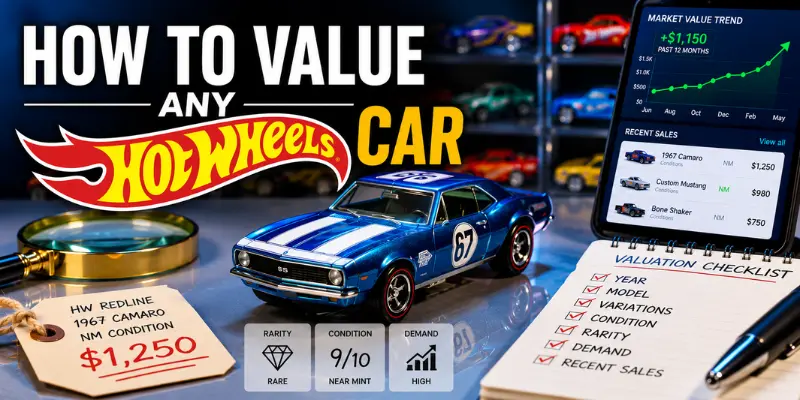
Step-by-Step: How to Value Any Hot Wheels Car
1. Flip It Over
Start with the base. Look for the casting name, copyright year, country, and manufacturer details.
Common base markings include:
- Hong Kong
- U.S.A.
- Malaysia
- Thailand
- China
- Indonesia
For vintage Redlines, Hong Kong and U.S. base variations can affect value.
2. Check the Wheels
Wheels give major clues.
Look for:
- Redline tires
- Blackwall wheels
- Real Riders
- Basic plastic wheels
- Special wheel variations
- Mismatched wheels
Real Rider rubber tires on a modern mainline-style car may indicate a Super Treasure Hunt, premium release, RLC car, or special edition.
3. Identify the Exact Version
Do not price the car by casting alone. A blue version, pink version, chrome version, or rare wheel variation can change value dramatically.
Search using the full description, not just the car name.
Example:
Instead of searching “Hot Wheels Camaro,” search:
“Hot Wheels 1968 Custom Camaro redline antifreeze Hong Kong”
The more exact your search, the more accurate your value estimate will be.
4. Grade the Condition Honestly
Use the C-scale for loose cars and inspect packaging carefully for carded cars.
Do not ignore small flaws. Paint chips, bent axles, cloudy windows, missing parts, and worn wheels all affect value.
5. Check Sold Prices, Not Asking Prices
Asking prices are not the market. A seller can list a $5 car for $500, but that does not mean it is worth $500.
Use sold listings to see what buyers actually paid.
6. Average Recent Comparable Sales
Find the last three to five sold examples in similar condition.
Compare:
- Same casting
- Same color
- Same wheels
- Same packaging status
- Similar condition
- Similar country/base variation
The average of those sales gives you a realistic market value.
Best Places to Check Hot Wheels Prices
Use more than one source before pricing expensive cars.
| Source | Best For |
|---|---|
| eBay Sold Items | Real recent market prices |
| WorthPoint | Older auction history |
| HobbyDB | Catalog-style collector reference |
| Online Redline Guide | Redline identification |
| Redline Price Guide | Redline sold prices and variants |
| HWtreasure | Treasure Hunt and Super Treasure Hunt identification |
| Facebook collector groups | Community feedback and quick sales |
| Toy shows | Real-world collector demand |
For Redlines, collector-focused guides are helpful because small variations can change value. Online Redline Guide describes itself as a collector-built reference for accurate Redline Hot Wheels information.
Where to Sell Hot Wheels
Choosing the right platform affects how much money you keep.
| Platform | Typical Fees | Best For |
|---|---|---|
| eBay | Around 12–14% depending on category and seller status | Rare Redlines, Supers, global buyer pool |
| Facebook groups | Usually 0% platform fee, PayPal Goods & Services may apply | Fast sales to collectors |
| Mercari | 10% seller fee on item price and buyer-paid shipping | Quick modern-car sales |
| Toy shows / swap meets | Table fee only | Bulk lots and networking |
| Auction houses | Often 10–20% seller commission | High-end collections and rare grails |
eBay says selling fees can include insertion fees and final value fees, and its fee structure varies by category and seller setup. Mercari’s current U.S. help page states that a 10% selling fee applies to item price and buyer-paid shipping for new and updated listings.
Simple Fee Example
If you sell a Super Treasure Hunt for $100:
- On eBay, you may keep around $86–$88 before shipping costs.
- In a Facebook group with no platform fee, you may keep closer to $97 if using PayPal Goods & Services.
- On Mercari, you may keep around $90 before shipping adjustments.
For low-value cars, fees may not matter much. For a $5,000 or $10,000 Redline, fees can make a major difference.
Should You Sell One by One or as a Lot?
Selling individually usually earns more money, but it takes more time.
Sell Individually If:
The car is rare
It is a Redline
It is a Super Treasure Hunt
It is an RLC or convention exclusive
It is carded and clean
It has a rare color or error
Sell as a Lot If:
The cars are common
Most are played-with
You want fast cash
You do not want to research each car
The collection is mostly modern mainlines
A smart strategy is to separate the top 10% of valuable cars and sell those individually. Then sell the rest in lots.
Photos You Should Include When Selling
Good photos help your car sell faster and reduce buyer complaints.
Include:
- Front of the car
- Back of the car
- Both sides
- Base stamp
- Wheels
- Paint chips
- Rivets
- Interior
- Windows
- Card front and back
- Blister close-up
- Card corners
- Treasure Hunt or TH logo
- Any error or rare feature
Use natural light and a clean background. Do not hide flaws. Serious collectors prefer honest listings.
How to Ship Hot Wheels Without Losing Value
Bad shipping can destroy value. A mint carded car can lose value instantly if the card arrives bent.
For carded cars:
- Use a protector case
- Wrap the protector in bubble wrap
- Ship in a sturdy box
- Do not use a bubble mailer
- Add padding around all sides
- Use tracking
For loose cars:
- Wrap each car separately
- Protect axles and wheels
- Avoid letting cars rub together
- Use a small box, not an envelope
- Add padding so the car does not move
For expensive Redlines or rare RLC cars, use insurance and signature confirmation.
How to Store and Protect Hot Wheels Value
Value you do not protect is value you lose.
Follow these storage rules:
- Keep carded cars away from sunlight.
- Use protector cases for valuable carded cars.
- Store loose cars in individual slots or cases.
- Avoid humid storage areas.
- Do not store valuable cars in garages with extreme heat.
- Keep Redlines away from moisture to reduce corrosion risk.
- Do not polish vintage Spectraflame paint.
- Do not straighten axles unless you understand restoration impact.
- Keep receipts and grading documents for expensive pieces.
Sunlight can fade cards and yellow blisters. Humidity can damage axles, metal bases, and bodies. Poor storage can turn a valuable collection into a low-grade lot.
When Should You Get a Hot Wheels Car Authenticated?
Professional grading or authentication makes sense when the car may be worth several hundred dollars or more.
Consider grading for:
Rare Redlines
Expensive Super Treasure Hunts
High-value RLC cars
Convention exclusives
Sealed rare cards
Prototype pieces
Rare colors
Cars with high fake risk
CAS offers grading and preservation for loose, carded, and boxed die-cast vehicles, including vintage Redline Hot Wheels and modern collector cars. UK Graders also lists diecast small car grading for carded Hot Wheels.
Grading is not always worth it for common cars. If the grading fee is higher than the car’s value increase, skip it.
Common Hot Wheels That Are Usually Not Valuable
Most Hot Wheels are common. That does not mean they are bad collectibles, but they may not be worth much money.
Usually low-value examples include:
Loose modern mainlines
Damaged common cars
Opened recent mainlines
Cars with missing wheels
Cars with heavy paint loss
Common fantasy castings
Duplicates from recent years
Cars from large mass-produced series
Many of these sell for $0.25 to $1 in bulk.
Hot Wheels That Are Worth Checking Twice
These are the cars you should not ignore:
- Vintage Redlines
- Pink, magenta, purple, brown, or antifreeze Redlines
- Rear-Loading Beach Bomb
- Custom Camaro
- Custom Volkswagen
- Olds 442
- Snake and Mongoose cars
- Early Treasure Hunts from 1995–1998
- Super Treasure Hunts
- RLC cars
- Convention exclusives
- Employee-only releases
- Factory errors
- Popular licensed castings
- Clean carded vintage cars
If you find any of these, research before selling.
Frequently Asked Questions
Most 1990s Hot Wheels are not very valuable. Common loose examples often sell for under a few dollars. The main exceptions are early Treasure Hunts, clean carded examples, rare variations, and collector-favorite castings.
For modern collectibles, opening the package usually lowers the value. A loose Super Treasure Hunt is often worth less than a sealed one. For vintage Redlines, many cars are already loose, so condition matters more than packaging.
The date on the base is usually the casting copyright year, not always the production year. To identify the actual release, compare the car’s color, wheels, base, interior, windows, and series with a collector database.
Some factory errors are valuable, but not all. Missing tampos, wrong wheels, upside-down bodies, unspun bases, or wrong cards can attract collectors. Damage after purchase is not an error.
A regular Treasure Hunt usually has a circle-flame symbol and is worth less. A Super Treasure Hunt usually has Spectraflame paint, Real Rider rubber tires, a “TH” logo, and a gold flame symbol on the card.
Yes, but most newer mainline cars are not valuable right away. Focus on Super Treasure Hunts, RLC releases, convention cars, premium sets, chase cars, and popular licensed castings.
Be careful. Light dusting is fine, but polishing, repainting, axle straightening, or deep cleaning can reduce value on vintage cars. Collectors often prefer original condition, even with honest wear.
Some loose Hot Wheels are valuable, especially Redlines, rare colors, Super Treasure Hunts, prototypes, and errors. However, common loose modern cars are usually worth very little.
Selling piece by piece usually brings more money, but it takes more time. Bulk sales are faster but usually bring less. A good strategy is to sell valuable cars individually and move common cars in lots.
Start with red-striped tires, Spectraflame paint, rubber Real Rider tires, Treasure Hunt symbols, RLC packaging, and unusual colors. These clues help you quickly separate possible valuable cars from common ones.
The Bottom Line
Most Hot Wheels are worth pocket change, but valuable ones can hide in plain sight. The key is knowing what to look for.
Start with two simple visual clues: red-striped tires and premium rubber tires with Spectraflame paint. Red-striped tires may point to vintage Redlines, while Spectraflame paint with Real Riders may point to a Super Treasure Hunt or premium collector release.
Then check the exact casting, color, wheel type, condition, packaging, and recent sold prices. Do not rely on asking prices alone. And before buying or selling expensive cars, inspect for repaints, drilled rivets, reproduction parts, and wheel swaps.
A dusty box of Hot Wheels may be worth $20, or it may contain a rare car worth hundreds or thousands. With the right identification steps, you will know whether your collection is common, collectible, or a hidden treasure.
You May Also Like It:
Electric Cars vs Diesel – Which One Is Better for Real Drivers?
Cryptobuzzthai com and Online Car Advice – What Drivers Should Check First
Cryptotrendsvn com – What Car Owners Should Know Before Trusting Online Information

- Be Respectful
- Stay Relevant
- Stay Positive
- True Feedback
- Encourage Discussion
- Avoid Spamming
- No Fake News
- Don't Copy-Paste
- No Personal Attacks
- Be Respectful
- Stay Relevant
- Stay Positive
- True Feedback
- Encourage Discussion
- Avoid Spamming
- No Fake News
- Don't Copy-Paste
- No Personal Attacks
